
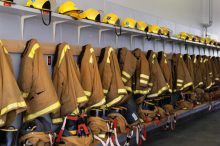
Indiana firefighters logged elevated levels of potentially hazardous PFAS chemicals in their blood serum, the state has found — with some connections to the frequency with which they handled firefighting foam, protective gear and specialized emergency responses.
PFAS is an abbreviation for perfluoroalkyl and polyfluoroalkyl substances. They have water, oil and heat-resistant properties but have been linked to health effects including potential increased risk of cancer.
The study, conducted by the Indiana Department of Homeland Security and external diagnostic laboratory Eurofins Scientific, was authorized in House Enrolled Act 1219 from 2023. The results were prepared by consultant Delineate and released last week, although the report is dated November.
“These findings confirm what firefighters and their families have been raising alarms about for years,” said the law’s author, Rep. Maureen Bauer, in a news release. “PFAS exposure is not isolated. It is systemic, occupational, and statewide. Because of (House Enrolled Act) 1219, we now have real data instead of unanswered questions.”
“Biomonitoring is about prevention and accountability,” added Bauer, D-South Bend. “You cannot fix what you do not measure. This program gives us the tools to protect the people who protect us.”
About 930 Hoosier firefighters — mostly active but some retired — responded to an initial online survey launched August of 2024 about their demographics, occupational history, potential exposure and more.
Respondents primarily served municipal fire departments, with about a quarter stationed in volunteer or combination departments and small numbers working for airports or industry, according to the report.
They were largely highly experienced, with 70% serving 15 years or more.
Testing performed
Of the 485 who reconsented to blood testing following procedural changes, 380 were selected in stratified random sampling and 316 returned their kits.
The samples were tested for 45 different PFAS analytes.
Most — 88% — had between 2 and 20 nanograms per milliliter of PFAS in their blood, putting them at medium risk of potential adverse health effects.
About 8.5% of those tested were in the low risk category, while 3.5% — all with 15 years or more of experience — were living at high risk.
The highest results were observed in two northwest Indiana Preparedness Districts, while the lowest came out of an east-central district.
Frequent exposure to PFAS-containing firefighting foams, which was self-reported, was statistically significantly associated with higher blood PFAS.
So was frequent contact with PFAS-containing equipment or gear, particularly among those handling or wearing gear on most or all shifts.
Residue on gear, along with dust in fire stations, can also contain PFAS.
Researchers observed a statistically significant association between how often firefighters decontaminated their gear and their biomarker category.
Firefighters who reported cleaning their gear after every exposure showed a modestly higher proportion of lower-level PFAS results, and those who rarely or never decontaminated it tended to cluster in the medium- or high-risk categories.
There was a similar trend for self-decontamination — like handwashing or showering — but it wasn’t statistically signifiant, according to the report.
Firefighters who frequently participated in hazardous materials response, water emergencies, construction-related rescues and other specialized tasks also recorded slightly higher PFAS concentrations.
About three-quarters of respondents reported at least some knowledge of PFAS safety, leaving a quarter with no awareness at all. Nearly all were at least moderately concerned about PFAS risks — especially those in higher-risk categories — but most hadn’t completed any safety training.
“This combination, broad concern and limited formal training, suggests strong receptivity to practical guidance, standardized procedures and targeted education at the department and state levels,” researchers wrote.
Recommendations made
The report called the results a “foundation” for further study.
“This pilot establishes an initial, preliminary baseline understanding of PFAS levels in a targeted population of Indiana firefighters,” researchers wrote. “While these data are not conclusive, they serve as a foundation for future, larger-scale efforts, enabling longitudinal studies that track changes in PFAS levels over time and correlate them with health outcomes.”
They recommended a variety of ways to reduce inhalation, skin and hand-to-mouth PFAS exposure: on-scene decontamination, bagging gear after use and laundering it promptly, keeping gear out of living spaces, HEPA-filtered vacuuming and wet-mopping, dedicated extractors and more.
They also aimed some suggestions at PFAS-containing foams: using non-PFAS alternatives “where mission-appropriate,” avoiding foams in training, pre-planning “containment” for emergency foam use and so on.
There are no approved medical treatments to remove PFAS from the body.

Formal safety training was another recommendation.
All active and retired firefighters should have access to voluntary serum testing, possibly with an exposure history survey, per the report.
But the state should also expand the scope of testing to measure non-occupational exposure, like how close respondents live to industrial sites, their primary drinking water sources and dietary habits — and sample for PFAS contamination in fire station dust, turnout gear, apparatus cabs and training grounds, researchers said.
The Indiana Department of Environmental Management could pursue federal and other grants to fund such work.
The study acknowledged some limitations, like challenges in establishing a baseline for PFAS levels.
New protocols for handling participant data were also introduced partway through the pilot, requiring a reconsent form. It came with delays and researchers “lost nearly half … of our sample,” limiting the data analysis they could perform.