


BURTON CELEBRATES CEREMONIAL SIGNING OF SEA 448 TO EXPAND CAREER PATHWAYS FOR INDIANA STUDENTS
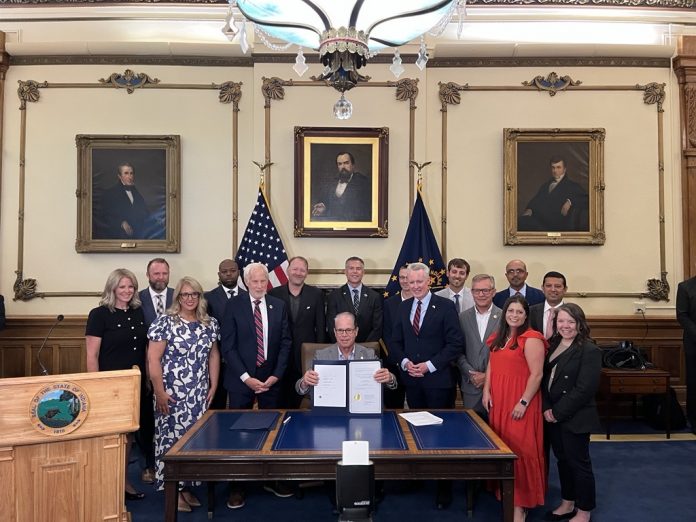
BURTON CELEBRATES CEREMONIAL SIGNING OF SEA 448 TO EXPAND CAREER PATHWAYS FOR INDIANA STUDENTS
INDIANAPOLIS – Today, State Rep. Alex Burton (D-Evansville) joined Gov. Braun and fellow lawmakers for the ceremonial signing of Senate Enrolled Act (SEA) 448 – bipartisan legislation that expands access to career pathways for Indiana students. Co-sponsored by Burton, the new law is a major step forward in equipping Hoosier youth with the tools they need to succeed after high school.
Burton released the following statement on the ceremonial signing:
“I’m honored to be part of the much-needed solutions that give Hoosier youth expanded access to career pathways. Enhancing the systems that develop youth into working and responsible Hoosiers is a high priority for me. Every student deserves the opportunity to prepare for life beyond graduation with the skills, credentials and confidence to pursue their future, whether that’s college, a career or military service.
“SEA 448 strengthens partnerships between schools, employers and postsecondary institutions to create more accessible career pathways. By investing in these opportunities and alternative tracks to success, the legislation aims to increase stability and independence for young people across the state.
“This is about building a future where students from every school district, not just a few, can explore options that don’t always require a four-year degree right away. I’m proud to work alongside our state’s top education leaders to ensure students graduate not just with a diploma, but with direction.”
###
NOTE TO THE PRESS: A photo of Burton attending the ceremonial signing is attached to this distribution.
Click here to download a high-resolution photo of Burton.
src=”blob:https://city-countyobserver.com/2de4bf17-89b6-4126-b4ff-178202fd4c11″ alt=”Burton_SEA448.jpg” type=”application/x-apple-msg-attachment” class=”Apple-web-attachment Apple-edge-to-edge-visual-media Singleton” style=”font-style: normal; font-variant-caps: normal; font-weight: 400; letter-spacing: normal; orphans: auto; text-align: start; text-indent: 0px; text-transform: none; white-space: normal; widows: auto; word-spacing: 0px; -webkit-text-stroke-width: 0px; text-decoration: none; caret-color: rgb(0, 0, 0); color: rgb(0, 0, 0); font-family: Helvetica; font-size: 13px; opacity: 1;”>
Governor Braun Celebrates Education Wins for Hoosier Students and Parents
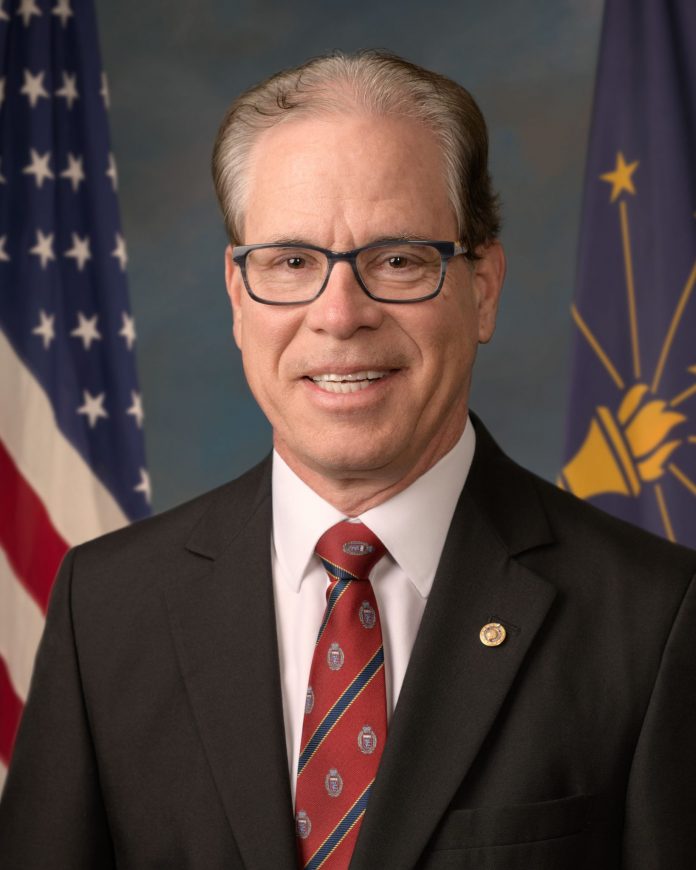
“Today we’re celebrating universal school choice, accountability, and new investment in our classrooms.”
INDIANAPOLIS – Today, Governor Mike Braun held a signing ceremony to celebrate education wins for Hoosiers, like universal school choice, increased teacher pay, sending more dollars to the classroom in the state budget, and bringing A-F accountability ratings to ensure Indiana schools are performing for Hoosier students.
“We’ve secured big wins for Hoosier students and parents, like universal school choice, increased teacher pay, new accountability ratings for schools, and more money going to the classroom. In Indiana, parents are in the driver’s seat of their kids’ education, and great quality education for Hoosier students is our priority.” – Governor Mike Braun
Governor Braun’s state budget strengthened Indiana’s commitment to K-12 education by increasing the K-12 tuition support formula by $640 million in the biennium. Governor Braun has also made parental choice a top priority in education, and the Choice Scholarship program will be open to all families beginning fall of 2026.
The bills being celebrated today also include increased teacher base pay and a new A-F accountability rating system focused on how well schools support the unique skills and talents of individual students.
Governor Braun ceremonially signed the following education bills.
• Senate Enrolled Act 146 – Teacher compensation.
• Senate Enrolled Act 448 – Higher education and workforce development matters.
• House Enrolled Act 1041 – Student eligibility in interscholastic sports.
• House Enrolled Act 1064 – School transfer.
• House Enrolled Act 1498 – School accountability.
• Senate Enrolled Act 373 – Various education matters.
• House Enrolled Act 1634 – Math education.
• House Enrolled Act 1515 – Education and higher education matters.
• Senate Enrolled Act 448 – Higher education and workforce development matters.
• House Enrolled Act 1002 – Various education matters.
• House Enrolled Act 1637 – School and public safety matters.
Otters fall short in extra inning opener

The Otters sent out Garret Simpson to the mound and he worked well throughout the first three innings. He stranded two runners in that three innings span and induced a ton of soft contact.
In the top half of the third, the Evansville offense got to work. After an Ellis Schwartz double with two outs, David Mendham drove him in to open the scoring in the Otters’ favor.
The next inning, Pavin Parks blasted a two-run home run to dead center field to make it 3-0. It wouldn’t end there, as Keenan Taylor hit an RBI triple to open it up even more at 4-0.
The Wild Things fought back immediately after with a lead off home run in the bottom of the fourth. In the fifth with a 4-1 deficit, Washington would score three times to tie it up at 4-4.
The game would stay even until the bottom of the seventh, when a sacrifice fly put the Wild Things ahead for the first time of the afternoon, 5-4.
The Otters did not give up. They responded with one of their own in the eighth. It was Graham Brown who delivered with a bloop single into shallow single to tie it up again, this time at 5-5.
Both teams matched each other until the end of regulation and it went into the tenth. The Otters were not able to score in the top half. Washington took advantage and won it with a walk off single down the right field line to make it a final of 6-5.
Parks had a solid day, going 3-for-4, a triple shy of the cycle. Mendham and Dennis Pierce each extended their on base streaks. Mendham is at 16 games, while Pierce is at 12.
The Otters are back in action tomorrow night in Washington at 5:05 p.m. CT.
Indiana’s Applied Behavior Analysis (ABA) Therapy Working Group Listening Sessions

INDIANAPOLIS — The Applied Behavior Analysis (ABA) Therapy Working Group, established through Executive Order 25-31, is hosting three listening sessions in July. These listening sessions will be an opportunity for families, providers, and community members to share their experiences and perspectives on ABA therapy in Indiana. Feedback gathered during these listening sessions will help inform the Working Group’s evaluation of cost containment strategies that minimize the negative impact felt by ABA enrollees and their families.
Listening Session Dates and Locations:
Thursday, July 10*
2-3 p.m. CT / 3-4 p.m. ET
Ivy Tech Valparaiso
3100 Tech Dr.
Room D226
Valparaiso, IN 46383
Tuesday, July 15
3-4 p.m. ET
Ivy Tech Richmond
2357 Chester Blvd.
Room 1239
Richmond, IN 47374
Thursday, July 24
2-3 p.m. CT / 3-4 p.m. ET
Ivy Tech Evansville
3501 N First Ave.
Room 107
Evansville, IN 47710
UE Alumnus Elected PGA of America Vice President, Poised for Future Presidency

EVANSVILLE, IND. (07/08/2025) The University of Evansville (UE) Purple Aces now have a powerful voice in pro golf: Nathan D. Charnes ’01. Charnes has been elected Vice President of the PGA of America, teeing up a new chapter of influential leadership on a global stage.
An Evansville native, Charnes earned a Bachelor of Science in Business Administration, majoring in Management with a minor in Marketing. After beginning his first year of college on a golf scholarship at the University of Indianapolis, he transferred to UE, where he discovered a community that felt like home.
“I really liked the community of people there,” Charnes shared. “It felt small town in the best way-a family environment where you couldn’t disappear, and everyone knew you and what you were involved in.”
During his time on campus, where he also met his wife, Eva, Charnes was a member of the Division I golf team and fully immersed himself in campus life. He became highly involved in his fraternity, serving in multiple leadership positions, including president, herald, IFC chair, social chair, and warden. Those experiences, along with his role as a student-athlete, taught him the importance of organization, time management, and accountability.
“Being that busy at UE shaped me into who I am today,” Charnes said. “It also taught me how important it is to treat people well and build relationships that last.”
Following graduation, though he initially resisted entering the golf business, Charnes realized it was his calling and embarked on a distinguished career in golf management. He joined WingHaven Country Club in O’Fallon, Missouri, in 2004, rising to General Manager and Director of Golf by 2011. Under his leadership, WingHaven has become a premier private club, recognized for exceptional member experiences, innovative programming, and continual growth.
Beyond the club, Charnes has been an engaged leader within the PGA of America for over two decades. His contributions span five national committees and numerous leadership positions, including service as President of his local Gateway PGA Section. His passion for expanding golf access led him to be involved in the establishment of PGA REACH Gateway, a regional foundation that has since grown into a national initiative dedicated to making the game more inclusive.
In November 2024, Charnes was elected Vice President of the PGA of America by his peers. Before this role, he served as Secretary of the PGA of America from 2023 to 2024, helping guide national membership initiatives and policy development. He began his two-year term as Vice President in 2025, positioning him among the association’s top executives and in line to serve as President of the PGA of America in 2027-2028.
Charnes’s achievements have earned widespread recognition, including induction into the Greater Evansville Golf Hall of Fame and the Indiana Sports Hall of Fame. He has received multiple PGA awards, such as Golf Professional of the Year and the Bill Strausbaugh Award for mentorship.
While his professional responsibilities keep him traveling across the country, Charnes remains connected to his UE roots, often receiving updates from his grandmother, Patricia Mitsos ’60, a longtime trustee of the University. He continues to follow the growth of the University’s golf programs and looks forward to engaging with student-athletes in the future.
Reflecting on his journey, Charnes encourages current students to get involved, embrace challenges, and build relationships, noting that those habits will serve them long after graduation. He also credits the University of Evansville for empowering him to step confidently into leadership. “UE was the place where I learned to balance competing priorities and to never lose sight of what really matters-treating people with respect and making a positive impact,” he said.

Changing birth certificates for desired genders is falsifying records, Attorney General Todd Rokita declares

Attorney General Todd Rokita is filing motions to intervene in cases in which Indiana trial courts have ordered the Indiana Department of Health (IDOH) to change the designation of sex on birth certificates to reflect preferred gender identities.
“We’re taking a stand not only for the rule of law but also for common sense,” Attorney General Rokita said. “Indiana law requires birth certificates to reflect the historical, immutable fact of a child’s sex. One should have no more ability to change the listed sex on a birth certificate years after the fact than to change the newborn’s listed length or weight.”
In dozens of instances, trial courts have ordered IDOH to change the historical record of a newborn’s sex.
The State of Indiana was not made a party to any of these cases, but according to Attorney General Rokita, the state has a clear interest in protecting the integrity of its own processes of issuing birth certificates.
Beyond existing state laws already providing clarity on these matters, Governor Mike Braun has issued an executive order instructing state agencies to interpret and apply “sex” to mean “an individual human being’s immutable biological classification as either male or female” as determined at conception.
HOT JOBS

|
||||||||||||||||||||||||||||||||||||||||||||||||||||||||||||||||||||
|
|


