

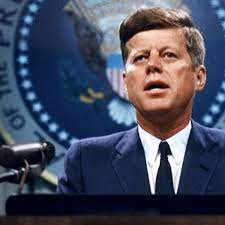
Today is the birthday of John F. Kennedy, born John Fitzgerald Kennedy in Brookline, Massachusetts (1917). When he was 43 years old Kennedy became the youngest man ever elected president of the United States (1961).
Kennedy was born into a wealthy family and lived at 83 Beals Street in the Coolidge Corner neighborhood of Brookline. His father, Joe, was a businessman and politician and his mother, Rose, was a philanthropist and socialite. He had seven brothers and sisters and his family summered in Hyannis Port, Massachusetts, and spent Christmas and Easter in Florida. He played sports avidly, joined Scout Troop 2, and exhibited a rebellious streak which peaked when he attended the exclusive Choate School in Connecticut. He exploded a toilet seat with a firecracker and was almost expelled, but his classmates still voted him “Most Likely to Succeed.â€
Kennedy, despite his zest for life, was often ill and was hospitalized off and on with what was later diagnosed as Addison’s disease. At Harvard, he swam varsity and got serious about his vocation, though the war intervened. Kennedy served in the United States Naval Reserve in World War II and endured a seven-day ordeal when the boat he commanded was sliced in half by a Japanese destroyer (1943). Kennedy and his men had to swim to shore for safety; Kennedy dragged one injured soldier using his teeth. After they were rescued, Kennedy was asked about his heroics. He responded, “It was involuntary. They sunk my boat.â€
Kennedy’s path to the presidency began when he represented Massachusetts’ 11th Congressional District in the U.S. House of Representatives (1947–1953). He later served in the U.S. Senate until his election as president in 1960. Along the way he authored the book Profiles in Courage (1957) which described acts of bravery by eight United States Senators throughout the Senate’s history. The book won a Pulitzer Prize (1958), making him the only president to have won a Pulitzer. He married Jacqueline Bouvier in 1955.
During his presidential campaign, Kennedy was asked if being a Catholic would affect his decision-making process. He responded, “I am not the Catholic candidate for president. I am the Democratic Party candidate for president who also happens to be a Catholic. No one asked me my religion [serving the Navy] in the South Pacific.â€
In September and October of 1960, Kennedy appeared in the first televised presidential debates with his Republican opponent, Richard Nixon, then vice president of the Unites States. During the first debate, Kennedy took advantage of the makeup services offered, and he appeared relaxed during the discussion. Nixon, on the other hand, was recovering from leg surgery, refused makeup, and appeared disheveled and sweaty during the debate. Nixon’s mother even called after the show to ask if he was sick.
People who watched the debate on television favored Kennedy, but those who listened on the radio thought Nixon did better. It was the moment when the medium of television entered — and influenced — politics for the first time. The election was the closest in 20th-century history, with Kennedy winning by just two-tenths of 1 percent (49.7 percent to 49.5 percent). Fourteen electors from Mississippi and Alabama refused to support Kennedy because of his progressive views on civil rights. They voted instead for Senator Harry F. Byrd of Virginia.
As president of the United States, John F. Kennedy broadened unemployment benefits, instituted the food-stamp program for low-income Americans, expanded Social Security, and increased library services and assistance for family farms. Actress Marilyn Monroe sang “Happy Birthday†to him on national television wearing a low-cut gold lamé dress.
On November 22. In 1963, President Kennedy was assassinated while riding in a motorcade in Dallas, Texas. He was just past his first thousand days in office. He was the youngest president to die while in office. His mother, Rose, donated his childhood home on Beals Street to the National Park Service.
In his inauguration speech, President Kennedy said:
“In the long history of the world, only a few generations have been granted the role of defending freedom in its hour of maximum danger. I do not shrink from this responsibility — I welcome it. I do not believe that any of us would exchange places with any other people or any other generation. The energy, the faith, the devotion which we bring to this endeavor will light our country and all who serve it — and the glow from that fire can truly light the world.
“And so, my fellow Americans: ask not what your country can do for you — ask what you can do for your country.”






(0) COMMENTS
Welcome to the discussion.
Keep it Clean. Please avoid obscene, vulgar, lewd, racist or sexually-oriented language.
PLEASE TURN OFF YOUR CAPS LOCK.
Don’t Threaten. Threats of harming another person will not be tolerated.
Be Truthful. Don’t knowingly lie about anyone or anything.
Be Nice. No racism, sexism or any sort of -ism that is degrading to another person.
Be Proactive. Use the ‘Report’ link on each comment to let us know of abusive posts.
Share with Us. We’d love to hear eyewitness accounts, the history behind an article.