Indiana House Republicans voted Friday to go along with President Donald Trump’s demand for redrawing the state’s congressional maps.
The House action sends the congressional redistricting issue to the state Senate, where its future is in real doubt. The Senate’s Republican leader has said for months that too few senators are in support for it to pass.
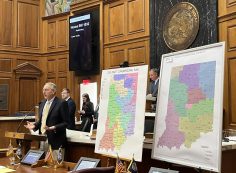
House members voted 57-41 in favor of the new maps crafted to produce a 9-0 Republican delegation by carving up the districts currently held by Democratic Reps. André Carson in Indianapolis and Frank Mrvan in the area along Lake Michigan near Chicago.
Twelve Republicans joined all Democrats present in opposing the bill.
Friday’s House debate occurred while a couple hundred people attended a pro-redistricting rally inside the Statehouse, where a Turning Point Action leader vowed major spending by the group to defeat Republican senators who vote against new maps.
At least 14 of the 40 Republican senators have publicly indicated opposition to redistricting, according to the Indiana Capital Chronicle’s tracking. Combined with the 10 Democratic senators, that total is just short of a majority in the 50-member Senate.
About 10 GOP senators have not made their position known.
Gov. Mike Braun maintained Friday he believed the Senate would approve the new maps, with opponents being “out of sync with most Republicans and conservatives in the state.”
Braun stood by threats that he and Trump have made to support Republican primary challengers against recalcitrant senators — and to keep up the pressure campaign if the Senate were to reject the new maps next week.
“Hopefully we won’t have to drag them through this more than what we’ve done so far,” Braun told reporters. “But it’s not over if they don’t do it.”
David McIntosh, president of the Washington-based Club for Growth and a former Indiana congressman, posted what he called a “FINAL WARNING” on social media to Republican Senate President Pro Tem Rodric Bray.
“Pass the new congressional map supported by President Trump and Hoosiers,” the post said. “Failure to get this done means you and any other opposition will be defeated and removed from office in your next election. Let’s get it done!”
The Senate is set to begin consideration of the redistricting plan on Monday, when the Senate Elections Committee will hold a public hearing lasting a maximum of four hours, according to Bray’s office.
A spokeswoman for Bray did not respond Friday to a request for comment from him about the House-approved maps. Bray has previously said he did “not feel that redrawing our Congressional districts mid-cycle is the best way to achieve that goal” of maintaining a Republican majority in the U.S. House.
The Senate is expected to take a final vote Thursday on the redistricting plan.
House debate one sided
Democratic House lawmakers denounced the proposed redistricting as a racial gerrymander for dividing Carson’s 7th District in Indianapolis — the state’s most urban and racially diverse — among four new districts. Those extend far into rural heavily Republican counties, with two of the proposed districts stretching to the Ohio River and another nearly reaching Lake Michigan.
Republican Rep. Ben Smaltz, author of the redistricting plan in House Bill 1032, repeated his stance that the new districts were drawn “purely for political performance” of GOP candidates and didn’t consider racial or other demographics.

House Speaker Todd Huston told reporters that the proposed map “is aligned” with the U.S. Supreme Court’s ruling this weekallowing Texas to use its new Republican-friendly map.
Justice Samuel Alito wrote that it was “indisputable” that Texas’ motivation for redistricting was “pure and simple” partisan advantage, which the court has previously ruled is permissible.
The Indiana House debate lasted for more than three hours, with 25 of the 30 Democratic members speaking against the bill and only two Republicans — Smaltz and Huston — speaking in favor of it.
Rep. Carolyn Jackson, D-Hammond, mocked Republicans as being largely unwilling to say anything positive about the redrawing.
“You may have said it at home, in your closet, in your basement, in the backroom where only you heard it,” Jackson said. “But you have not said it here. You have not said it to your neighbors. You’ve not said it to any of us.”
House Republicans divided as well
Trump started the national redistricting fight by pushing Texas Republicans to redraw its congressional map this summer and it has spread to other states including California, Missouri and North Carolina. The pressure on Indiana Republicans has included trips in August and October by Vice President JD Vance to Indianapolis.
Huston said while he supported the current Indiana congressional districts drawn by Republicans in 2021, he argued the national political landscape had changed since then.
“We don’t operate in a vacuum and states are doing this all across the country, red and blue states,” Huston told reporters. “We felt like it was important for us to be a part of that, and to make sure that we used every tool we could to support a strong Republican majority.”
Huston did not predict success in the Senate for the redistricting plan and declined to say what the next step would be if it was defeated in that chamber.
“It’s been a long week,” he said. “We’ll deal with whatever happens.”
Friday’s House vote showed a divide among the chamber’s Republican leadership on the issue.
The 12 GOP members voting against the bill included House Majority Floor Leader Matt Lehman of Berne, Speaker Pro Tem Mike Karickhoff of Kokomo and Majority Caucus Chair Greg Steuerwald of Avon, who was the lead sponsor of the 2021 redistricting bill.
Democrats on Friday lambasted Republicans for the map proposal that lacks compactness and divides several cities.
Rep. Matt Pierce, D-Bloomington, said the new maps indicate the Republicans believe that Democrats “really shouldn’t exist.” He argued that having an all-Republican delegation would hurt Indiana if Democrats regain control of the U.S. House.
“Now the state of Indiana has no one within, potentially, the majority party to talk about things like appropriations, to work together on getting specific things done for the state,” Pierce said. “You lose that.”
After Friday’s debate, Huston was asked by a reporter whether he was “proud” of the redistricting plan. He responded by saying “I am very blessed to lead the Indiana House of Representatives. I support this, and I support what we’re doing.”