
AUTHOR MICHAEL NORDINE
One of the greatest gifts America ever received was originally envisioned for another nation. Before creating “Liberty Enlightening the World,” as the Statue of Liberty is officially known, French sculptor Frédéric Auguste Bartholdi set to work on “Egypt Carrying the Light to Asia,” which was meant to be placed at the entryway of the Suez Canal in Port Said, Egypt. It would have looked fairly similar to Lady Liberty, with an “Upper Egyptian” (Saeid Misr) wearing a robe and holding a torch. Bartholdi was inspired by a trip to Abu Simbel, the site of two iconic temples devoted to Ramesses II, and planned the sculpture to stand 86 feet high on a 48-foot pedestal.
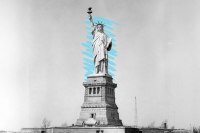
However, the statue was deemed too costly to produce, and the Port Said Lighthouse was erected instead. Bartholdi then repurposed his design after turning his attention to America due to a proposal by Édouard de Laboulaye, a French historian and abolitionist who wanted to honor the century-old alliance between the U.S. and France, as well as America’s successful effort to abolish slavery. The monument, renamed the Statue of Liberty, was constructed in France and presented to Levi Morton, then the U.S. ambassador to France and later vice president under Benjamin Harrison, in a ceremony in Paris on July 4, 1884. Following its completion the next year, it was disassembled and shipped to New York City, where it still stands today.